
Customising a 0.77-Inch OLED for Coffee Machines and Appliance Panels at Volume
Appliances such as coffee machines need a display that reads clearly, survives heat and steam, and can be produced by the tens of thousands with a consistent appearance. A 0.77-inch monochrome OLED with a 128x64 resolution and an SPI interface is a reasonable building block for that, but turning it into a shipped appliance panel is a customisation and production exercise, not a matter of dropping in a stock module. The work is in the bezel, the seal, the connector strategy and the test that keeps every unit looking like the first.
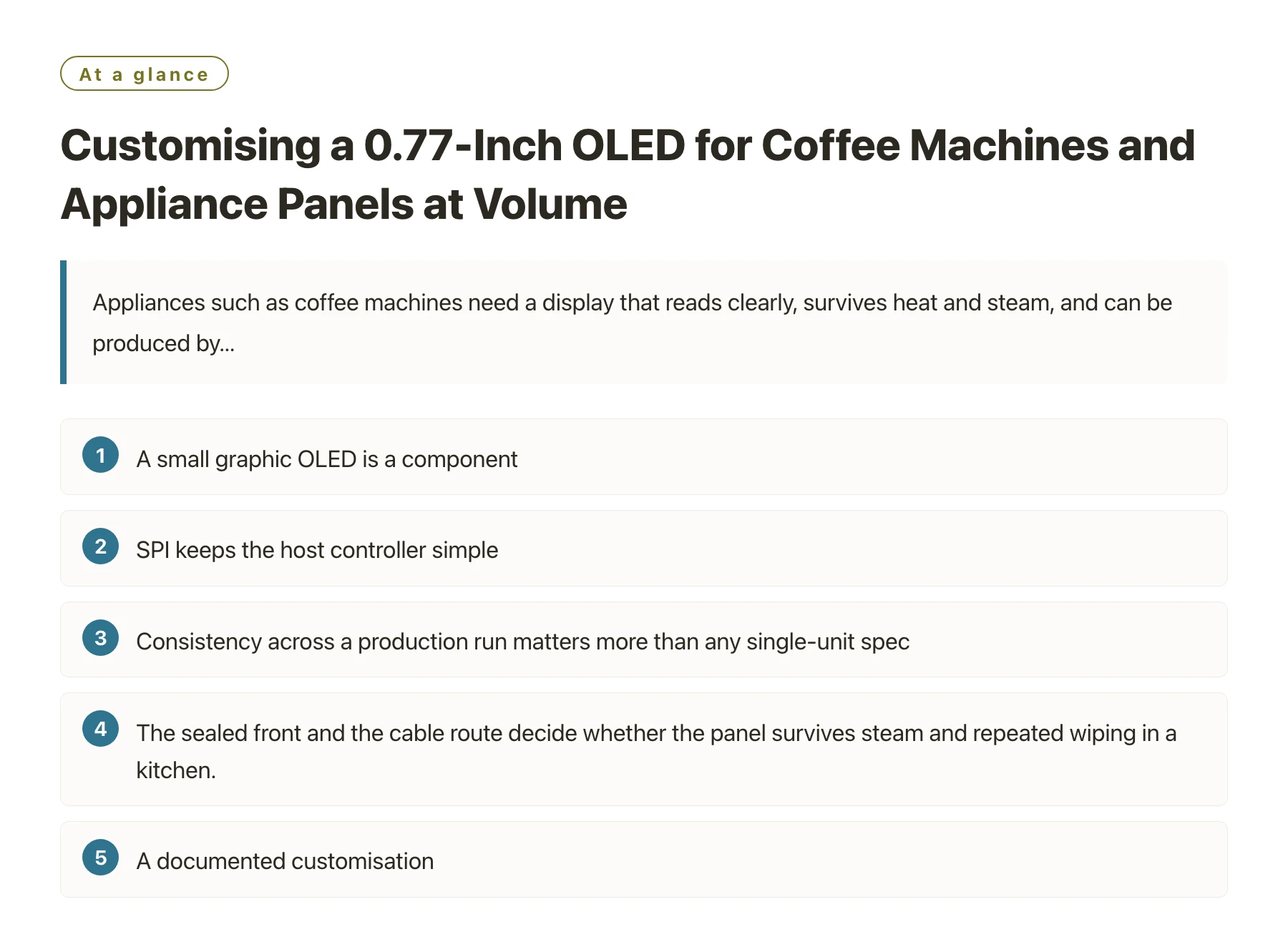
Key takeaways
- A small graphic OLED is a component, not a finished panel, so the bezel, gasket and connector are where appliance-grade customisation lives [1].
- SPI keeps the host controller simple, which helps when the display is one of many subsystems on a cost-sensitive board.
- Consistency across a production run matters more than any single-unit spec, because a visible tint or alignment shift reads as a defect.
- The sealed front and the cable route decide whether the panel survives steam and repeated wiping in a kitchen.
- A documented customisation, not an ad-hoc mount, is what lets a contract manufacturer repeat the build reliably.
In a coffee machine or a similar appliance, the display is both a functional readout and a visible piece of the product's finish. It has to survive a warm, humid, frequently wiped environment and still look identical across a long production run. Those are production-engineering requirements as much as electrical ones.
The OLED itself is a mature, low-power graphic device, which is why it fits appliances that cannot afford a large or power-hungry screen. But the bare module is not appliance-ready: it needs a sealed front, a strain-relieved cable and a bezel that frames it without trapping moisture.
This article walks the customisation path from a stock module to a repeatable appliance panel, emphasising the unglamorous steps that decide whether the product ships cleanly.
The panel is the easy part
The electrical integration of a 128x64 SPI OLED is well understood: a few signal lines, a controller-init sequence and a bitmap buffer. That part is solved the first time and then reused. The hard part is everything around the glass.
Appliance panels live behind a front surface that users touch, wipe and spill on. The seal between that surface and the display must keep steam out of the optical path and the electronics, and the bezel must hold the panel without stressing the glass. These are mechanical and process decisions, not display-spec decisions.
Getting them right once and documenting them is what lets a contract manufacturer build the same unit ten thousand times. Getting them wrong produces intermittent field failures that no panel specification will predict.
From stock module to appliance panel
| Step | Why it matters | Failure if skipped |
|---|---|---|
| Sealed front | Blocks steam and wipes | Fogging and corrosion |
| Strain-relieved cable | Survives vibration and pulls | Intermittent connection |
| Bezel and mount | Frames without stressing glass | Cracked or tilted panel |
| Appearance check | Consistent tint and alignment | Visible unit-to-unit defect |
| Production test | Screens every unit | Escaped dead pixels |
Consistency is the production goal
On an appliance the customer compares units on a shelf, so a panel that looks slightly different from its neighbour reads as a quality problem even if it functions perfectly. Holding tint, contrast and alignment within a window across the run is therefore a production requirement, not a nicety.
That consistency is achieved by locking the module revision, controlling the bezel tooling and running a simple per-unit appearance and dead-pixel check. None of these are exotic; all of them are easy to skip under schedule pressure and expensive to recover later.
DisplayModule display modules in this size are supplied as the graphic engine; the appliance-grade panel is the customisation built around them, and the build documentation is the deliverable that protects the run.
The same module is also offered with an I2C variant on the identical mechanical outline, which matters when the appliance controller is pin-starved or already runs a shared peripheral bus [2]. Keeping that alternative visible during layout avoids a board respin if the SPI signals are later needed for a motor driver or a sensor front end, and it lets a thin adapter in the display driver support either bus without rewriting the instrument firmware. For a high-volume appliance the cost of leaving that option open at design time is essentially zero, while the cost of discovering the constraint after tooling is a new board spin and a requalification of the whole front panel.
For appliances, plan the seal, the cable relief and the per-unit appearance check before volume. The OLED is the stable part; the surrounding customisation is what decides field quality.
Sources
Frequently asked questions
Is a 128x64 OLED enough for an appliance UI?
For status, icons, a clock and short prompts it is enough, and its low power and small size suit appliances. Richer content would argue for a larger panel, not for overloading this one.
What makes the panel survive a kitchen?
A sealed front that keeps steam out of the optics and electronics, plus a strain-relieved cable and a bezel that does not stress the glass. Those are customisation steps around the module.
Why is consistency across units emphasised?
Customers compare adjacent units, so a tint or alignment shift reads as a defect even when the panel works. Holding appearance within a window is a production requirement.
Does SPI limit the appliance design?
At this resolution SPI is ample and keeps the host simple and cost-effective, which suits a display that is one subsystem among many on the board.
Ready to hear your track mastered?
Drop a stereo bounce. Pick a target — Spotify, Apple Music, Netflix, BBC iPlayer, or CD. Get a broadcast-loud, release-ready master back in under 90 seconds.
Start a Free Master →