
Evaluating Chinese OEM Factories for a Home Fragrance Line
Evaluating a Chinese OEM factory for a home fragrance line is a scorecard exercise, not a tour. The five criteria that predict success are category experience, process documentation, compliance readiness, IP hygiene and communication discipline, and each one can be checked with a question rather than a handshake. A candle or reed diffuser line fails on different points than a fine fragrance line does, so the evaluation has to be built for the category. This article gives the scorecard and the questions that fill it in.
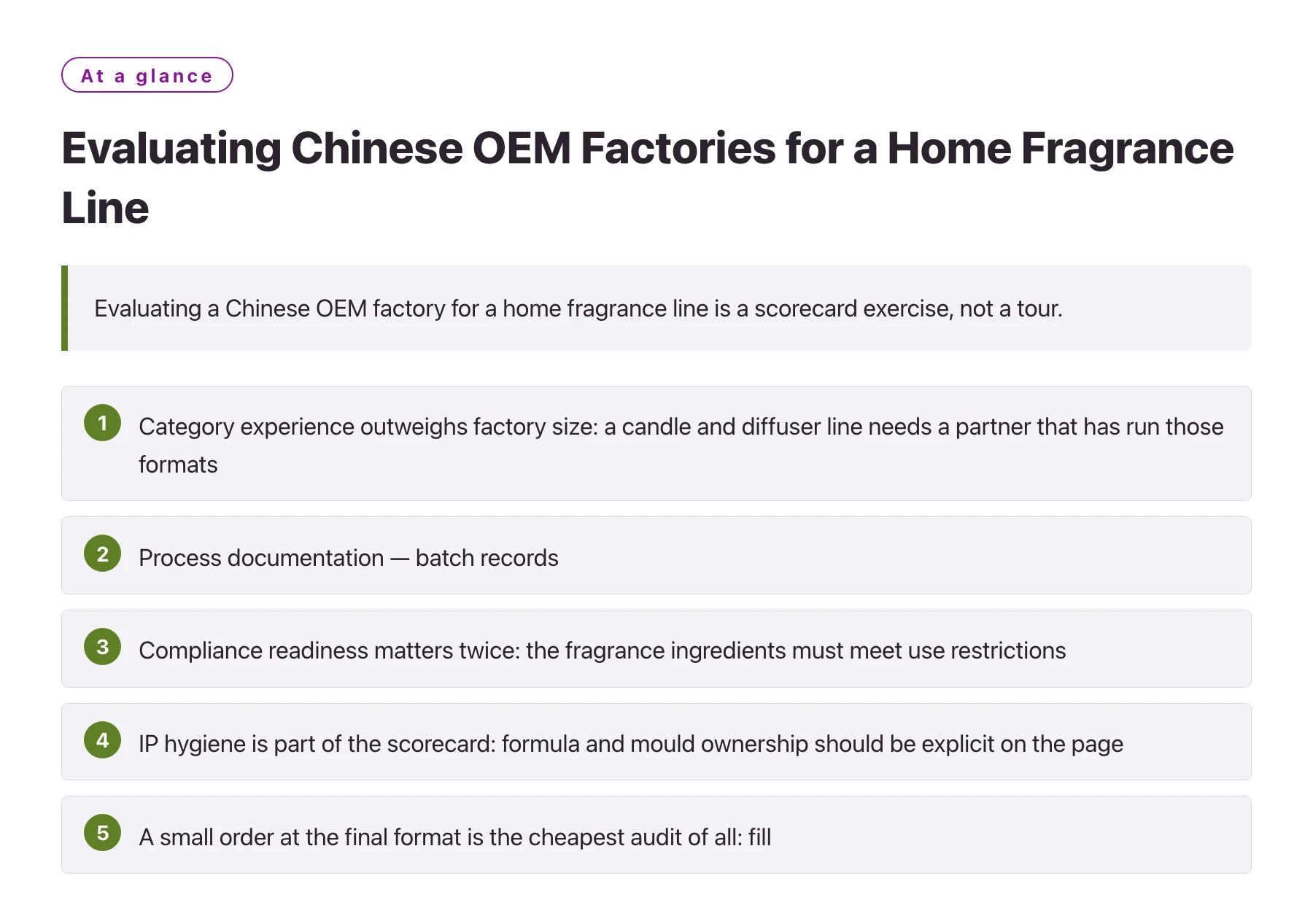
Key takeawaysCategory experience outweighs factory size: a candle and diffuser line needs a partner that has run those formats, not just perfume bottles. · Process documentation — batch records, retained samples, written approval steps — is the strongest predictor of a repeatable home fragrance line. · Compliance readiness matters twice: the fragrance ingredients must meet use restrictions, and the finished home product must satisfy the destination market's cosmetics or consumer-product rules [1]. · IP hygiene is part of the scorecard: formula and mould ownership should be explicit on the page, and registration only helps if the brand holds it [4]. · A small order at the final format is the cheapest audit of all: fill, wick or reed behaviour and packaging tolerance show up there, not in the showroom.
Most supplier evaluations for a home fragrance line start with the wrong question: can you make candles? Every factory can claim that. The right question is narrower: can you make my candle, at my volume, to my tolerance, with my documents, season after season?
The scorecard below converts that question into five criteria that can be checked systematically, with the questions that belong to each one.
Running the evaluation in five moves
- Shortlist by category evidenceAsk for home fragrance references in candles, diffusers or room sprays — not general claims of fragrance experience.
- Request the process packBatch records, retained samples and written approval steps from a recent home fragrance run.
- Check compliance readinessIngredient restriction data for the fragrance, and the market file for the finished product in each destination.
- Clarify ownership on the pageFormula, mould and design files: who owns them, in writing, before tooling.
- Run a pilot at final formatOne small batch of the actual product tells you what the showroom cannot.
A scorecard you can reuse
| Criterion | What to look for | Weight |
|---|---|---|
| Category experience | Run samples and references for candles, diffusers or room sprays | High |
| Process documentation | Batch records, retained samples, fill and wick check sheets | High |
| Compliance readiness | Restriction data for the fragrance; market file for the finished product [2] | High |
| GMP orientation | A documented quality system such as ISO 22716 applied to home fragrance runs [3] | Medium |
| IP and ownership | Written formula, mould and design-file ownership; registration evidence | Medium |
| Communication | Structured updates, written approval steps, named contacts | Medium |
Score each line after the visit, not during it, with evidence attached. The weight column is a starting point; a line that fails high-weight criteria should end the evaluation on its own.
Category-specific pitfalls in home fragrance
Home fragrance has failure modes that perfume bottles do not. Candles fail on wick behaviour, wax composition and burn-time claims; reed diffusers fail on evaporation rate and oil-to-base ratio; room sprays inherit the labelling rules of the markets they ship to, because in several jurisdictions they are regulated consumer products [1]. If the interview is all about scent and nothing about burn time or evaporation, the evaluation is incomplete.
The same documentation discipline applies as in fine fragrance: the batch record should run from raw material intake to the packed unit, and the retained sample should survive the seasons you promise customers.
The visit checklist
Walk the line that actually makes your category, ask to see the batch record of the run you are evaluating, weigh a filled unit against the declared spec, and open the packing station to check how the finished box is handled. Someone evaluating a a Chinese factory for perfume brands should leave with the same confidence they would need in Guangzhou or anywhere else: the process is written down, the numbers are real, and the people can explain them.
The relationship criteria
Two softer criteria predict as much as the hard ones. First, whether the supplier volunteers constraint information before you ask for it — categories that behave differently, minimums that surprise, documentation you will need. Second, whether the named contact stays with the project from sample to bulk. A fragrance OEM/ODM production partner that rotates staff mid-project externalizes its own coordination cost to you.
The cheapest evaluation is the pilot, and the most expensive is the first bulk order without one. If a factory resists a small run at the final format, that resistance is a finding, not a detail.
Turning the scorecard into a decision
Total the scores after the process pack, the visit and the pilot. If two suppliers land close, revisit the high-weight lines: category experience and documentation almost always separate them in the end.
Established manufacturers tend to make this easier by publishing their scope and certification list. A house such as Xuelei Fragrances, which manufactures across fragrance categories in Guangzhou and documents its systems publicly, gives an evaluator a baseline to check against — which is useful regardless of whether it wins the order, because the comparison itself becomes more honest.
Sources
- European Commission: Cosmetics in the EU —— The European Commission's overview of EU cosmetics rules, including the responsible person, product information file and safety report requirements.
- IFRA Standards Library (International Fragrance Association) —— The IFRA Standards Library lists the restrictions the fragrance industry applies to individual fragrance ingredients, based on safety assessments; it is the reference point for compliant fragrance formulation.
- SGS: Cosmetics, Personal Care & Household Testing —— Testing, inspection and certification services for cosmetics and personal care, including microbiological, stability and safety testing aligned with cosmetics GMP.
- WIPO — World Intellectual Property Organization —— The UN agency for intellectual property; resources on industrial design and patent protection relevant to product and packaging design.
Frequently asked questions
Why does category experience matter more than factory size?
A candle or diffuser line has its own failure modes — wick behaviour, evaporation rate, packaging tolerance. A large factory new to the category is riskier than a specialist with run samples for your exact format.
What is the strongest predictor of a repeatable home fragrance line?
Process documentation. A supplier that can show batch records, retained samples and written approval steps from a recent run is describing a system; one that cannot is describing hope.
Do home fragrance products need compliance documentation?
Yes. The fragrance ingredients sit inside use restrictions, and the finished product is regulated in several markets as a consumer product, with labelling and notification requirements that vary by destination.
How can I check IP ownership with a Chinese OEM factory?
Make it a written clause: formula, mould and design files, who owns each, and what happens when the relationship ends. Registration through national or international routes only helps if the brand, not the supplier, holds it.
What should the pilot order prove for a home fragrance line?
That the candle burns to its claimed time, the diffuser evaporates predictably, the fill is within tolerance, and the packaged unit matches the approved prototype. Prove those four on a small run before any bulk commitment.
Ready to hear your track mastered?
Drop a stereo bounce. Pick a target — Spotify, Apple Music, Netflix, BBC iPlayer, or CD. Get a broadcast-loud, release-ready master back in under 90 seconds.
Start a Free Master →