
First Visit to a Pool's Front Page: Four Questions Before 158 TH/s Points Anywhere
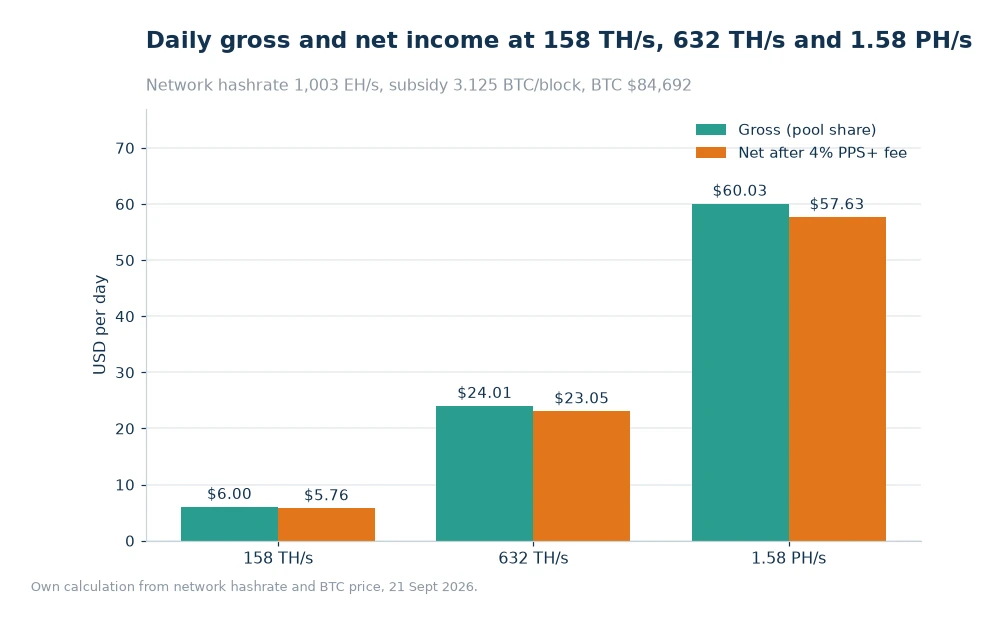
A pool's homepage is written for strangers, which makes it a poor place to look for detail and a good place to look for coherence. One mid-size machine at 158 TH/s earns about 0.00007088 BTC a day, $6.00 gross and $5.76 after the listed 4% on the block-reward part. Four questions decide whether the page in front of you describes a place worth pointing that machine at.

Key takeaways
- At 158 TH/s the expected credit is 0.00007088 BTC a day, which is $6.00 at $84,692 and $5.76 net of the listed 4%.
- Check four things on any pool page: payout mode, settlement timing, coin coverage and withdrawal terms.
- A page that states the fee per component is easier to compare than one that advertises a single headline number.
- Scale the arithmetic to your own plan before signing up; a 1.58 PH/s fleet is ten times the single-machine case.
What a stranger can and cannot learn from a landing page
Front pages exist to answer one question: is this the right kind of service for me. They are bad at the second question, which is whether the numbers work at my size. That is not a criticism of any particular site; it is how marketing pages are built. The skill is to read the page for categories and then do the arithmetic yourself.
Categories are still valuable. A pool that names its payout modes, lists supported coins, publishes fees per component and links to a statistics view has told you that it expects to be compared. A page that offers only an earnings headline and a sign-up button has told you something too, mostly about the amount of work its operator expects you to do afterwards.
Four questions, in the order they matter
The first is payout mode. Two modes are common in this market: one that pays a steady amount against current difficulty, and one that shares the pool's actual block findings over a window. The first smooths the daily credit and charges a listed fee on the block-reward component; the second pays after confirmations and charges a listed fee on the combined total. A page that explains that difference in plain words is a page written by someone who has explained it before, and the fee schedule is where the numbers should be readable without a support ticket.
The second is settlement timing. Hourly, daily, or on threshold. The third is coin coverage, which matters if the machine will ever be pointed at something other than bitcoin. The fourth is withdrawal terms, including whether mining payouts carry a fee of their own. Those four answers, written down, make two pools comparable; without them you are comparing logos.
Where a single machine sits against the fleet
The table puts three sizes side by side, because the front page talks in aggregate and a buyer thinks in units. The same per-terahash rate produces all three rows, and the difference between them is only how many machines are plugged in.
| Setup | Hashrate | BTC per day | BTC per 30 days | Net USD per day |
|---|---|---|---|---|
| One machine | 158 TH/s | 0.00007088 | 0.002126 | $5.76 |
| Four machines | 632 TH/s | 0.00028352 | 0.008506 | $23.05 |
| A small hall | 1.58 PH/s | 0.00070880 | 0.021264 | $57.63 |
The monthly column is what a landlord or an electrician will ask about. It is also the column that makes the fee question concrete: at 1.58 PH/s the gap between gross and net is $2.40 a day, which is $72 a month, and a page that hides the fee structure behind a link is hiding a number of that size.
Worked example: from a front-page claim to a daily figure
Suppose the page says the pool issues about 450 BTC a day across a network of 1,003 EH/s. Rebuild the single-machine case.
- One terahash earns 450 ÷ 1,003,000,000 = 0.00000044865 BTC a day.
- At 158 TH/s: 158 × 0.00000044865 = 0.00007089 BTC, which the chart carries as 0.00007088.
- In dollars: 0.00007088 × 84,692 = $6.00 gross.
- Net after the listed 4% on the block-reward part: 6.00 × 0.96 = $5.76.
- Multiply by ten for 1.58 PH/s: 10 × $6.00 = $60.03 gross and $57.63 net.
That is the whole test of a landing-page claim. If a pool quotes a daily earning, you can rebuild it in five lines; if your rebuild lands somewhere else, the difference is either a fee you have not read about or an assumption about difficulty that the page did not state.
The numbers a marketing page usually leaves out
Three omissions are so common they are almost conventional. The first is what happens when a block is found late, which is a timing question rather than a rate question. The second is the spread between the published network hashrate and the one your own dashboard implies; a 2% gap changes the daily figure by 2%, and nobody advertises it. The third is the cost of getting coins out, including the minimum withdrawal and the network fee at the time you press the button.
None of these are scandals. They are simply details that belong on a fee page or a support article rather than a hero section, and a visitor who knows to go looking for them arrives at a fair comparison faster. The Statistics page is a reasonable place to start, since pool hashrate and network hashrate are the two inputs a buyer needs and both are usually published there.
Reading the page as a promise about operations
Beyond the numbers, a front page is a statement about how the service expects to be run. A pool that lists mining farms, a wallet, a loan product and an app is signalling that it wants to hold the whole relationship; one that lists only a stratum address is signalling the opposite. Neither is wrong, but they suit different operators, and the mismatch usually shows up six weeks in when a need appears that the chosen pool does not cover.
The ViaBTC Bitcoin Mining entry point is built around that broader relationship, which is worth noticing if the plan includes holding coins, converting them, or borrowing against them later. For a single machine the extra products are irrelevant on day one and useful by month three, and that is a normal arc for a mine that starts small.
Frequently asked questions
What should I check first on a mining pool homepage?
The payout modes and the fee attached to each. A page that separates the listed fee on the block-reward component from the fee on transaction fees is easier to compare than one that quotes a single number, and at 158 TH/s the difference is $0.24 a day.
Can one machine at 158 TH/s mine a whole block?
Practically no. At 158 TH/s against a 1,003 EH/s network the share of each day's 450 BTC is 0.00007088 BTC, and solo block discovery at that size is measured in decades rather than weeks, which is why pool membership is the usual route.
Does the homepage price include difficulty changes?
No. Any figure shown is arithmetic on the difficulty at the time it was written. With 132.76 T in September 2026 and an estimate of −2.12% for the next adjustment, a daily figure can move within weeks without anything else changing.
Write the four answers down before you sign up
Open a note, type four headings, and fill them from the pages you visit. Payout mode with its listed fee, settlement timing, coin coverage, withdrawal terms. If any heading stays empty after ten minutes, that is the answer that decides the question, and no amount of polished front-page copy compensates for it. Then do the five-line rebuild at your own hashrate and keep the result beside the note.
Sources: ViaBTC homepage, statistics and pricing pages; chain inputs read 21 Sept 2026: network hashrate 1,003 EH/s, difficulty 132.76 T, subsidy 3.125 BTC per block, 144 blocks a day, BTC $84,692. Published 24 Oct 2026[1].