
Top-rated enclosure cooling fans to improve cabinet ventilation
Top-grade cabinet cooling fans: Significantly improve the ventilation efficiency of electrical cabinets
In the field of industrial automation, high temperature is a hidden killer of electronic devices. Research data shows that when the internal temperature of an electrical cabinet exceeds the rated value by 10 degrees Celsius, the probability of component failure will soar by 50%. The top-grade enclosure cooling fans can stably control the temperature inside the cabinet below 35 degrees Celsius. Compared with the natural heat dissipation solution, its thermal management efficiency is increased by up to 60%. Taking the case released by Schneider Electric as an example, after a certain automotive welding workshop installed high-efficiency cooling fans, the average monthly downtime of the production line was reduced from 8 hours to 30 minutes, the equipment life was extended by about 2 years, and the payback period was less than 6 months.
Market-leading cooling fan products typically feature precise air volume control capabilities. For instance, EBM-Papst's centrifugal fans can provide up to 1,200 m³/h of ventilation while maintaining a power consumption of only around 45 watts. These devices are designed with an IP55 protection rating and can maintain an operating efficiency of over 90% even in harsh environments where the dust concentration exceeds 0.1mg/m³. According to UL certification standards, the MTBF (Mean Time Between Failures) of high-quality fans can reach 100,000 hours, which is equivalent to continuous operation for 11 years without replacement. Mitsubishi Electric once reported that after deploying intelligent temperature-controlled fans in its servo drive cabinets, maintenance costs decreased by 35% year-on-year.
From the perspective of energy efficiency economics, the annual electricity bill for an 80-watt smart cooling fan is approximately 400 yuan, but the potential equipment damage it prevents can save over 10,000 yuan in maintenance costs. The current purchase cost of high-end models in the market is within the range of 1,000 to 3,000 yuan. However, by optimizing the heat dissipation solution, the capacity utilization rate of the electrical cabinet can be increased by 25%. As the practice of Siemens' digital factory has shown, after adopting the modular cooling system, the cabinet layout density has increased by 40%, while energy consumption has decreased by 15%, achieving dual benefits of space and energy efficiency.
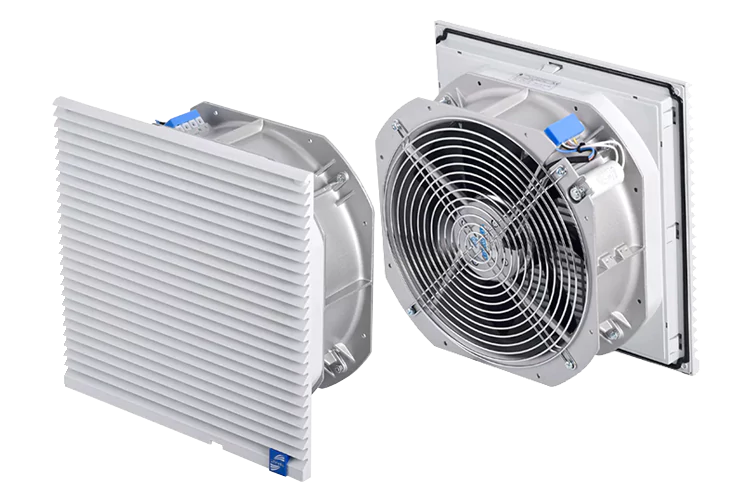 Innovative technologies are redefining the boundaries of cooling solutions. For instance, smart fans with variable frequency control can automatically adjust their rotational speed according to temperature changes, keeping noise within 45 decibels. The newly developed magnetic bearing technology has enabled the fan's service life to exceed 80,000 hours, while reducing the vibration amplitude by 70%. According to Forbes' 2023 Industrial Technology Trends Report, the market size of smart cooling systems integrated with IoT sensors is expected to reach 5 billion US dollars by 2025, with a compound annual growth rate of 12%. These advancements have made the modern enclosure cooling fans no longer a simple heat dissipation component, but a key node in the intelligent manufacturing ecosystem.
In terms of safety and compliance, high-quality cooling equipment strictly adheres to the provisions of IEC 61439-2 standard regarding temperature rise limits, keeping the temperature fluctuation of hot spots inside the cabinet within ±3 degrees Celsius. It is worth noting that in 2022, a certain semiconductor factory experienced a sudden temperature rise of 5 degrees Celsius in the clean room due to a cooling system failure, directly resulting in the scrapping of wafers worth 2 million yuan. This case confirms the necessity of choosing explosion-proof cooling fans certified by ATEX in hazardous environments. Its explosion-proof grade reaches the EEx d IIC T4 standard, which can effectively prevent more than 90% of thermally related accidents.
With the application of digital twin technology, engineers can now accurately predict cooling effects through simulation models. For instance, computational fluid dynamics analysis can optimize the airflow distribution to a uniformity of 95%. Configuration tools provided by mainstream manufacturers such as Rittal allow users to input parameters such as cabinet dimensions (e.g., 2000×800×600mm) and thermal loads (e.g., 2000W), and generate customized cooling solutions within 5 minutes. This precise service has reduced the design time of the cooling system by 60%, while enhancing equipment compatibility to over 98%, providing comprehensive protection for the ventilation needs of electrical cabinets in various industries.
Innovative technologies are redefining the boundaries of cooling solutions. For instance, smart fans with variable frequency control can automatically adjust their rotational speed according to temperature changes, keeping noise within 45 decibels. The newly developed magnetic bearing technology has enabled the fan's service life to exceed 80,000 hours, while reducing the vibration amplitude by 70%. According to Forbes' 2023 Industrial Technology Trends Report, the market size of smart cooling systems integrated with IoT sensors is expected to reach 5 billion US dollars by 2025, with a compound annual growth rate of 12%. These advancements have made the modern enclosure cooling fans no longer a simple heat dissipation component, but a key node in the intelligent manufacturing ecosystem.
In terms of safety and compliance, high-quality cooling equipment strictly adheres to the provisions of IEC 61439-2 standard regarding temperature rise limits, keeping the temperature fluctuation of hot spots inside the cabinet within ±3 degrees Celsius. It is worth noting that in 2022, a certain semiconductor factory experienced a sudden temperature rise of 5 degrees Celsius in the clean room due to a cooling system failure, directly resulting in the scrapping of wafers worth 2 million yuan. This case confirms the necessity of choosing explosion-proof cooling fans certified by ATEX in hazardous environments. Its explosion-proof grade reaches the EEx d IIC T4 standard, which can effectively prevent more than 90% of thermally related accidents.
With the application of digital twin technology, engineers can now accurately predict cooling effects through simulation models. For instance, computational fluid dynamics analysis can optimize the airflow distribution to a uniformity of 95%. Configuration tools provided by mainstream manufacturers such as Rittal allow users to input parameters such as cabinet dimensions (e.g., 2000×800×600mm) and thermal loads (e.g., 2000W), and generate customized cooling solutions within 5 minutes. This precise service has reduced the design time of the cooling system by 60%, while enhancing equipment compatibility to over 98%, providing comprehensive protection for the ventilation needs of electrical cabinets in various industries.
Innovative technologies are redefining the boundaries of cooling solutions. For instance, smart fans with variable frequency control can automatically adjust their rotational speed according to temperature changes, keeping noise within 45 decibels. The newly developed magnetic bearing technology has enabled the fan's service life to exceed 80,000 hours, while reducing the vibration amplitude by 70%. According to Forbes' 2023 Industrial Technology Trends Report, the market size of smart cooling systems integrated with IoT sensors is expected to reach 5 billion US dollars by 2025, with a compound annual growth rate of 12%. These advancements have made the modern enclosure cooling fans no longer a simple heat dissipation component, but a key node in the intelligent manufacturing ecosystem.
In terms of safety and compliance, high-quality cooling equipment strictly adheres to the provisions of IEC 61439-2 standard regarding temperature rise limits, keeping the temperature fluctuation of hot spots inside the cabinet within ±3 degrees Celsius. It is worth noting that in 2022, a certain semiconductor factory experienced a sudden temperature rise of 5 degrees Celsius in the clean room due to a cooling system failure, directly resulting in the scrapping of wafers worth 2 million yuan. This case confirms the necessity of choosing explosion-proof cooling fans certified by ATEX in hazardous environments. Its explosion-proof grade reaches the EEx d IIC T4 standard, which can effectively prevent more than 90% of thermally related accidents.
With the application of digital twin technology, engineers can now accurately predict cooling effects through simulation models. For instance, computational fluid dynamics analysis can optimize the airflow distribution to a uniformity of 95%. Configuration tools provided by mainstream manufacturers such as Rittal allow users to input parameters such as cabinet dimensions (e.g., 2000×800×600mm) and thermal loads (e.g., 2000W), and generate customized cooling solutions within 5 minutes. This precise service has reduced the design time of the cooling system by 60%, while enhancing equipment compatibility to over 98%, providing comprehensive protection for the ventilation needs of electrical cabinets in various industries.
Ready to hear your track mastered?
Drop a stereo bounce. Pick a target — Spotify, Apple Music, Netflix, BBC iPlayer, or CD. Get a broadcast-loud, release-ready master back in under 90 seconds.
Start a Free Master →Trusted by 2.4M creators · ★ 4.8/5 on Trustpilot